
AI website builder vs traditional website builder: which one wins in 2026?
 Natallia Usava for Academy
When you need a website for your business, two modern paths unfold before you: the lightning-fast automation of AI or the familiar, hands-on control of traditional builders. Which is the smarter choice? This isn't just about tech specs—it’s about what’s best for your time, budget, and vision. As AI tools explode in popularity, with searches for “AI website builder” surging 500% between 2022 and 2025, the decision has never been more relevant .
Let’s cut through the hype and look at what really matters in the AI vs. Traditional Website Builders 2026 showdown.
New to AI builders? First, a quick primer: what is an AI-powered website builder.
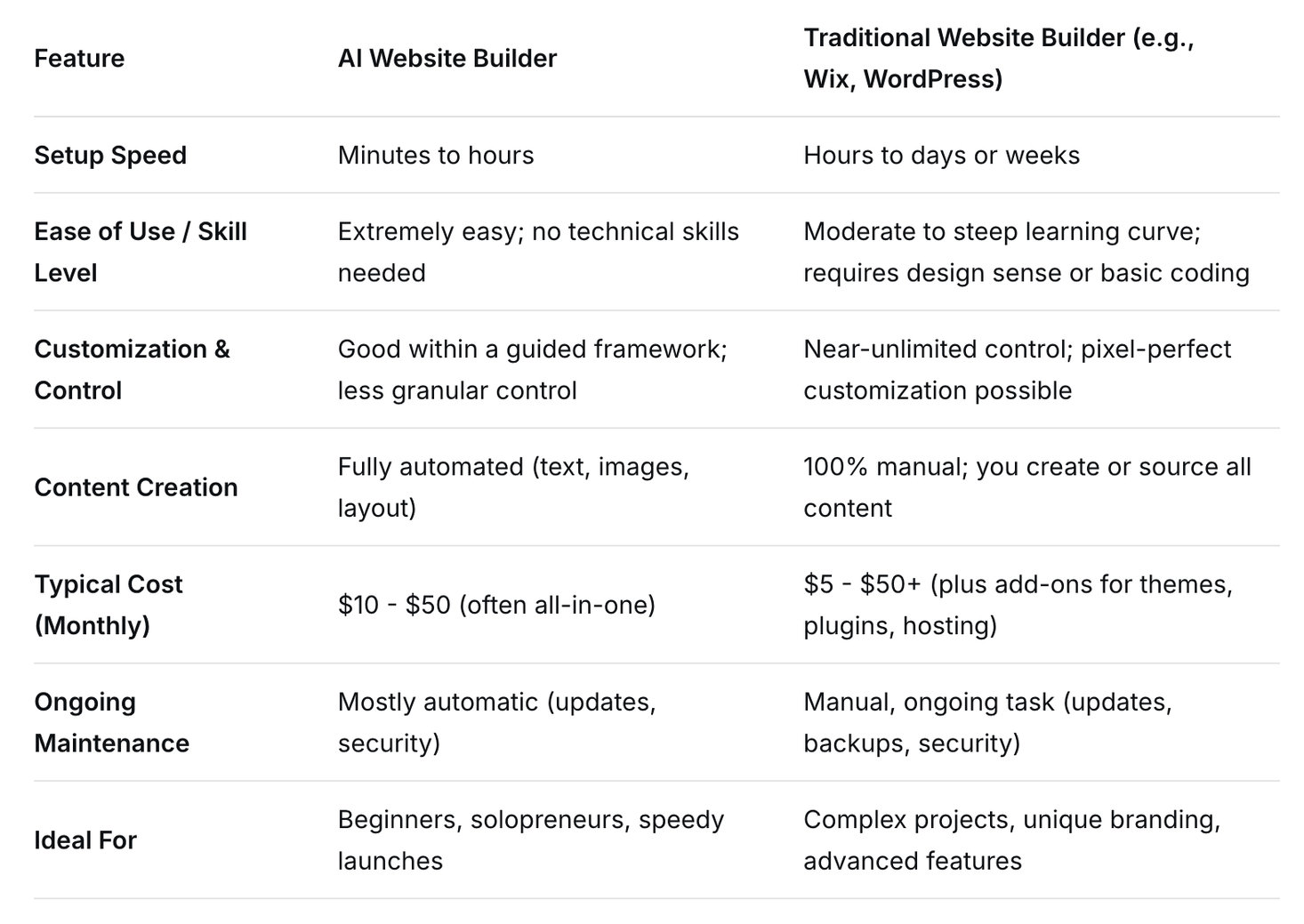
Head-to-Head: the core differences
To understand which tool fits your project, start by looking at how they approach the fundamental task of building a site.
The case for AI website builders: speed and simplicity
For many small businesses, the appeal of AI builders is immediate and powerful. Imagine describing your business and having a complete, professional website in under 10 minutes. That’s the promise they deliver on.
- Unmatched Speed: The difference is staggering. AI can assemble a site in 5 to 15 minutes, while even a basic traditional build can take 2 to 8 hours. For a local shop or freelancer needing to launch yesterday, this is a game-changer.
- Democratized Design: You don't need to be a designer or coder. By answering a few simple questions about your industry and style, the AI handles the heavy lifting of layout, writing initial copy, and even selecting images. This guided process is ideal for the 58% of small business owners who cite a lack of time and digital skills as major hurdles.
- Built-in Best Practices: A good AI builder automatically ensures your site is mobile-responsive, sets up a basic SEO-friendly structure with clean URLs and headings, and applies consistent design across all pages.
- Predictable, All-in-One Cost: The subscription fee typically bundles the builder, hosting, security (SSL), and support, preventing surprise costs from premium plugins or developer fees.
The Trade-off: This incredible convenience comes at the cost of deep creative control. You work within the AI's design framework, which can lead to sites that feel familiar or lack a truly unique brand identity if your input is vague.
The case for traditional builders: ultimate control and flexibility
Traditional builders like WordPress, Wix, or Squarespace are the established giants for a reason. They offer a blank canvas (or a vast library of templates) for those who know exactly what they want.
- Pixel-Perfect Customization: This is their superpower. You can tweak every element, inject custom code, and create truly unique layouts that stand out from the crowd. For a brand with a strong visual identity, this control is non-negotiable.
- Handles Complex Projects: Need a custom booking system, a unique user portal, or complex e-commerce integrations? Traditional platforms, with their extensive ecosystems of plugins and the ability to edit code directly, are built for this level of complexity.
- Mature Ecosystem & Ownership: These platforms have massive communities, endless tutorials, and proven reliability. With self-hosted options like WordPress, you own your site's code and data, giving you the freedom to move it wherever you want.
The Trade-off: This power demands resources. You need time (15-30 hours for a basic site is common), design skill, and a willingness to handle ongoing manual maintenance like updates and security.
The hidden factor: the real cost of your time
The price tag is only part of the story. A real-world comparison for a financial services website revealed a critical insight: while the AI-built site was fast and clean, the human-designed version had superior visual hierarchy, more engaging imagery, and stronger calls to action.
This highlights a common pitfall: an AI can give you a website, but it may not give you an effective marketing asset. If the site doesn't convert visitors, you might end up spending more later to hire a professional to redesign it. For straightforward sites, AI's speed is a bargain. For projects where design directly impacts sales, the initial investment in a traditional builder (or a designer) might save money long-term.
Making your choice: a simple decision framework
Still unsure? Answer these five questions :
What’s your timeline? Need to launch this week? → Lean towards AI.
What’s your budget? Under $3,000 and needing to keep costs predictable? → Lean towards AI. Have more to invest in unique development? → Traditional is viable.
How unique does your site need to be? A standard brochure site or portfolio is fine? → AI excels. Require complex features or a one-of-a-kind design? → You likely need a Traditional builder.
What are your technical skills? Zero coding or design experience? → AI is built for you. Comfortable learning platforms and managing details? → Traditional offers more reward.
Who will handle updates? Want a "set-and-forget" site? → AI automates maintenance. Have the time and interest to manage the site yourself? → Traditional gives you the keys.
The emerging middle ground: hybrid & AI-assisted tools
The lines are blurring. Many traditional builders are now integrating AI assistants (like Wix ADI or Divi AI) to help generate copy or suggest layouts. Conversely, some advanced AI builders (often called "vibe coding" tools like Lovable or v0) generate actual code that developers can then tweak and export. For many, this hybrid approach—using AI for the heavy lifting of the first draft, then refining it with human creativity—represents the best of both worlds.
Final verdict: it’s about the right tool for your job
The debate isn't about which technology is "better," but which is better for you right now.
- Choose an AI Website Builder if: You’re a small business owner, freelancer, or entrepreneur who needs a professional online presence fast, with minimal technical hassle and a predictable cost. It’s the ultimate tool for turning an idea into a live website over your lunch break.
- Choose a Traditional Website Builder if: Your project demands specific, complex functionality, you have a strong, unique brand vision, or you have the time and skills (or budget to hire them) to build and maintain a bespoke digital experience.
If you're a freelancer specifically, see our pick of the best AI website builders for freelancers in 2026.
In 2026, AI website builders have firmly established themselves as the go-to for speed and accessibility, while traditional builders remain the undisputed champions of control and customization. By understanding your own priorities, you can confidently choose the path that gets you a website that doesn't just exist—but works.
Related articles

Natallia Usava
Head of 🌱kvitly. She commands time and a little space, knows everything about the needs of clients, loves to smile, and gets goosebumps at the sound of a cello.
Are you ready?
Explore 🌱kvitly with no limits within the trial period of 14 days. No commitment, no credit card required.
Let’s try!