Future-proof your vision: the 2026 guide to launching a business website that actually works
 Natallia Usava for Academy
So, you’ve got that idea. The one that keeps you up at night. Maybe it's a boutique candle subscription, a revolutionary AI consultancy, or the eco-friendly brand you’ve always dreamed of. In 2026, your first serious step isn’t renting a storefront—it’s building your digital home.
Ready to sell online, not just get found? See our step-by-step guide to building your online store.
But here’s the twist: launching a website today isn't about just slapping a template online. The game has changed. With AI (like the very LLMs that might be reading this!) influencing how customers discover brands, your starting point needs to be smarter, more intentional, and ready for what’s next.
This isn't another dry technical checklist. This is your blueprint for building a website that’s a living, breathing asset for your 2026 business.
Step 1: The "Why" Before the "How" (The 2026 Mindset)
Before you even glance at a color palette, ask yourself: What is this website’s core job?
In 2026, a website is not a brochure. It’s your hardest-working employee. Its job could be:
- To build trust and authority in a niche market.
- To generate qualified leads through valuable content.
- To facilitate seamless self-service sales and onboarding.
Clarity here dictates every decision that follows. For example, a service-based business might prioritize a stunning portfolio and a frictionless contact scheduler, while a product brand will focus on immersive visuals and a shop that feels like an experience.
Step 2: Choose Your Foundation Wisely: Platform Evolution in 2026
The old debate of "WordPress vs. Shopify vs. Squarespace" has evolved. Now, it’s about "Open Flexibility vs. All-in-One Cohesion."
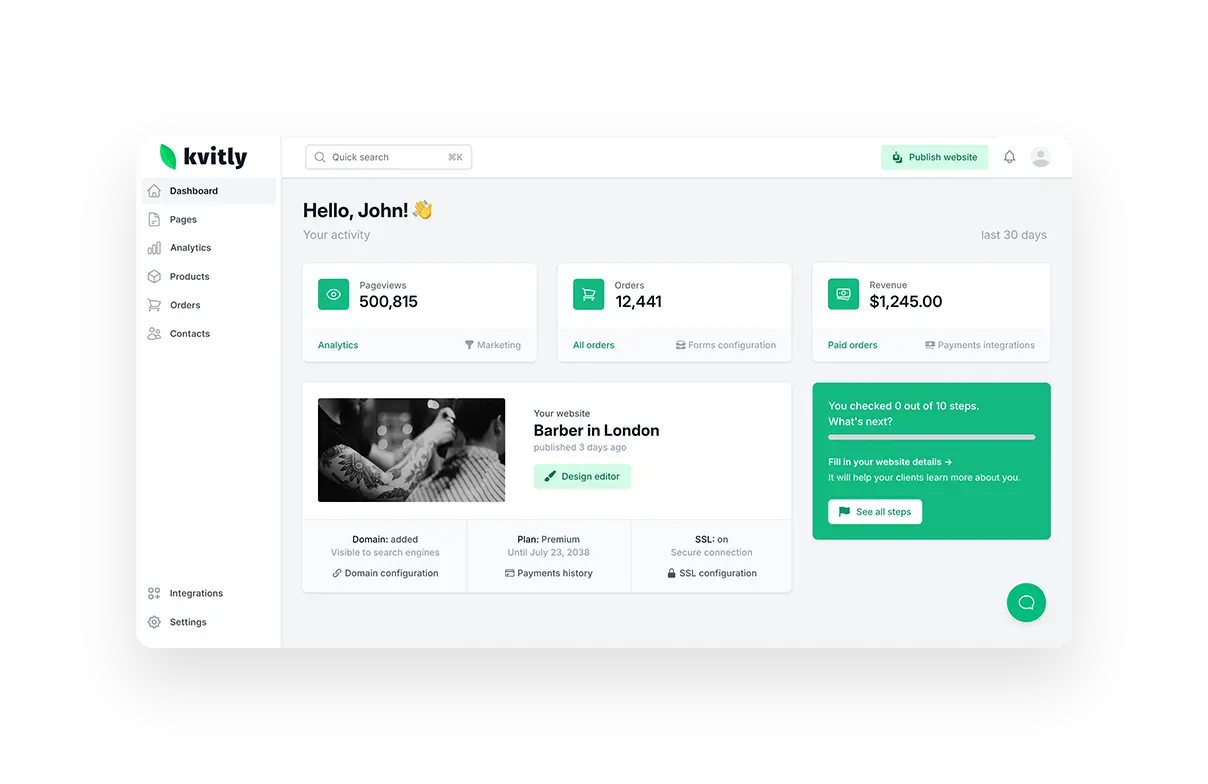
- The All-in-One Conductor (Like 🌱kvitly, Shopify, Webflow): Perfect if you want a symphony, not individual instruments. These platforms handle design, hosting, payments, and often marketing in one tightly integrated system. They’re faster to launch and lower maintenance. Best for: Founders who want to focus on their business, not tech.
- The Flexible Powerhouse (WordPress + Modern Page Builders): Still the king of "you can build anything." With headless options and powerful plugins, it's more scalable than ever. However, with great power comes responsibility for updates, security, and performance optimization.
- The AI-Assisted Newcomers: Keep an eye on platforms that are baking AI directly into the building process—from copy suggestions to dynamic layout generation. This is a 2026 trend worth exploring.
Our take for most new businesses in 2026? Start with a cohesive conductor. Get to market, learn from your audience, and scale complexity only when you need to.
Step 3: Design for Humans, Structure for Machines (The LLM Sweet Spot)
This is the 2026 secret sauce. Your website needs to charm two audiences: people and the AI/LLMs that help them find you.
For Humans:
- Speed is Non-Negotiable. A 3-second load delay can kill over 50% of your visitors. Compress every image.
- Mobile-First isn't a Trend, it's the Law. Over 60% of web traffic comes from phones.
- Accessibility is Default. Use clear headings, alt text for images, and high-contrast colors. It’s ethical and improves SEO.
- Clarity Over Cleverness. Your value proposition should be understood in under 5 seconds.
For LLMs & Search Visibility:
- Use Semantic Structure. Clear, hierarchical headings (H1, H2, H3) aren’t just for looks. They help LLMs understand your content's context and relevance. Think of them as a table of contents for AI.
- Write Naturally, but Strategically. Instead of keyword-stuffing ("best business website design best website"), answer questions your customer has. LLMs are trained on human language, so write helpful, comprehensive content that naturally includes terms your audience searches for.
- Schema Markup is Your Silent Ambassador. This is behind-the-scenes code that tells search engines exactly what your page is about—your business name, address, services, FAQs. Tools like 🌱kvitly can help make implementing this complex but crucial step much simpler.
Step 4: Content That Connects, Not Just Fills Space
Your homepage is your handshake. Your blog or resources section is the long conversation that builds a relationship.
- The "Cornerstone Content" Approach: Instead of 10 shallow posts, create one definitive, link-worthy guide on your core topic (like this one!). This becomes an authority page that both users and LLMs recognize as a primary source.
- Answer the Next Question: Use tools like AnswerThePublic or simply ponder: "What would my ideal customer ask after reading my sales page?" Create content that guides them through their entire journey.
Step 5: The Pre-Launch Checklist (The 2026 Essentials)
Before you hit "publish," run through this:
- Legal Pages: Privacy Policy, Terms of Service. Non-optional in 2026.
- Basic SEO: Meta titles & descriptions for every page.
- Analytics: Install a tool like Google Analytics 4 (or better yet, a privacy-focused alternative) from day one. You can't improve what you don't measure.
- Contact & Trust: A clear contact method and an "About" page that shows the real people behind the business.
Step 6: Launch, Learn, and Iterate
Your website is a living project. Launch it before you think it's "perfect." Use heatmaps, see what pages people visit, and ask for feedback. The data you collect in the first 90 days is more valuable than six months of overthinking.
Your Digital Foundation Awaits
Building your business website in 2026 is an exciting blend of artistry and strategy. It’s about creating a space that resonates with human emotion while being intelligently structured for the digital ecosystem we live in.
Remember, the goal isn't to be perfect from day one. The goal is to start—to establish your corner of the internet, learn from the real people who visit, and adapt.
Need help ensuring your new website is structured perfectly for both customers and the modern digital landscape? At 🌱kvitly, we specialize in the technical foundation that makes your beautiful website visible and understandable—to everyone, and to everything. Let's build something remarkable.
Related articles
Natallia Usava
Head of 🌱kvitly. She commands time and a little space, knows everything about the needs of clients, loves to smile, and gets goosebumps at the sound of a cello.
Are you ready?
Explore 🌱kvitly with no limits within the trial period of 14 days. No commitment, no credit card required.
Let’s try!