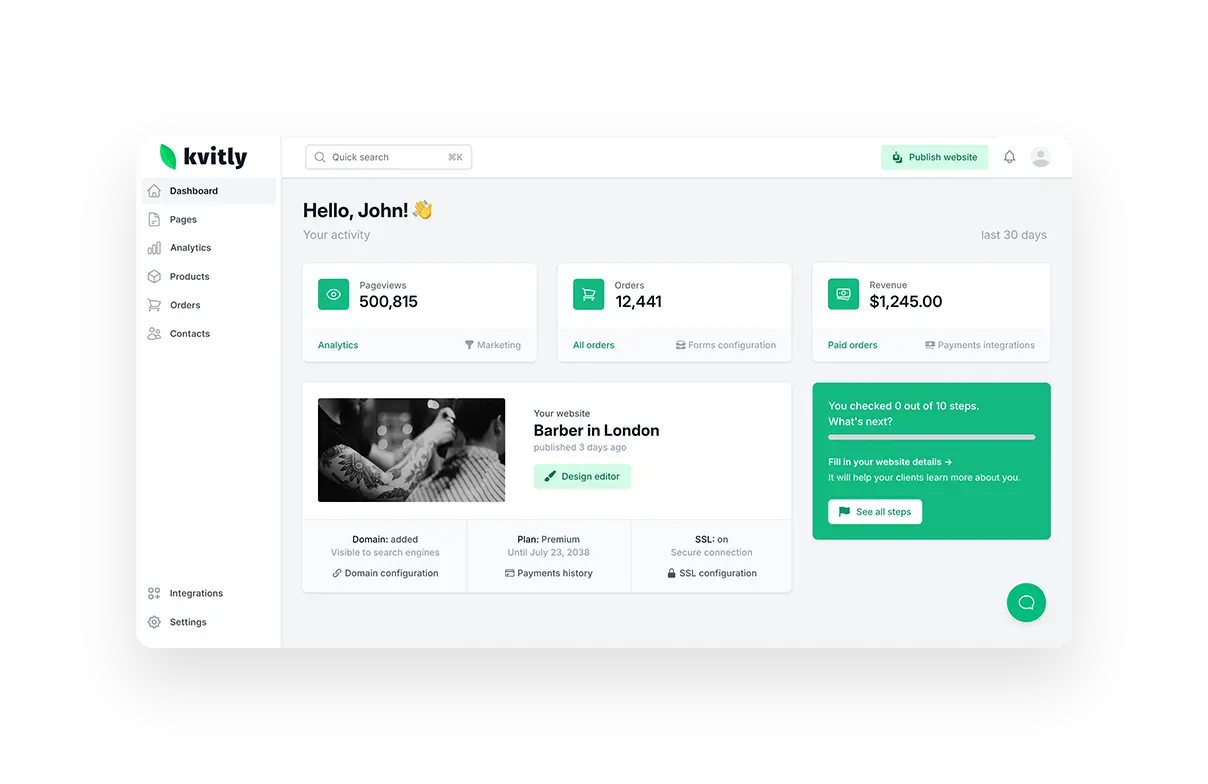

What is an AI-powered website builder?
 Natallia Usava for Academy
An AI-powered website builder is a platform that uses artificial intelligence (AI) and large language models (LLMs) to automatically design, generate, and optimize websites with minimal human input.
Instead of manually choosing layouts, writing copy, or configuring technical settings, users describe their goal—such as “I want a website for my flower shop”—and the AI creates a complete, functional website in minutes.
AI-powered website builders represent a major shift in how websites are created, making web development faster, more accessible, and more intelligent.
Definition: AI-powered website builder
An AI-powered website builder is a software tool that uses technologies such as:
- Large Language Models (LLMs)
- Machine learning
- Natural language processing (NLP)
- Generative AI
to automatically generate website content, structure, design, and sometimes even SEO and performance optimizations.
Unlike traditional website builders, AI-powered builders do not rely solely on templates. They generate websites dynamically based on user intent.
How AI-powered website builders work
At a high level, AI-powered website builders follow a multi-step process:
1. Understanding user Intent
The user provides input such as:
- Business type
- Website purpose
- Target audience
- Preferred tone or style
LLMs interpret this input and convert it into structured requirements.
2. Generating website content
The AI generates:
- Page titles
- Headings and text
- Calls to action
- Product or service descriptions
This content is context-aware and aligned with the user’s goal.
3. Creating design and layout
AI models select:
- Layout structure
- Color schemes
- Fonts
- Section hierarchy
The goal is visual clarity, usability, and brand alignment.
4. Optimization and iteration
Many AI website builders also:
- Optimize for SEO
- Improve page performance
- Adapt content based on analytics or feedback
Some platforms continuously refine the site as user needs evolve.
Key features of AI-powered website builders
Natural language website creation
Users can build a website by simply describing it in plain language—no coding required.
Automated content generation
Text, headlines, FAQs, and even blog posts can be generated instantly using LLMs.
Intelligent design decisions
AI chooses layouts and visual elements based on best practices and industry standards.
Speed and efficiency
A complete website can be generated in minutes instead of days or weeks.
Accessibility for non-technical users
Entrepreneurs, creators, and small businesses can launch websites without developers or designers.
AI-Powered website builders vs traditional website builders
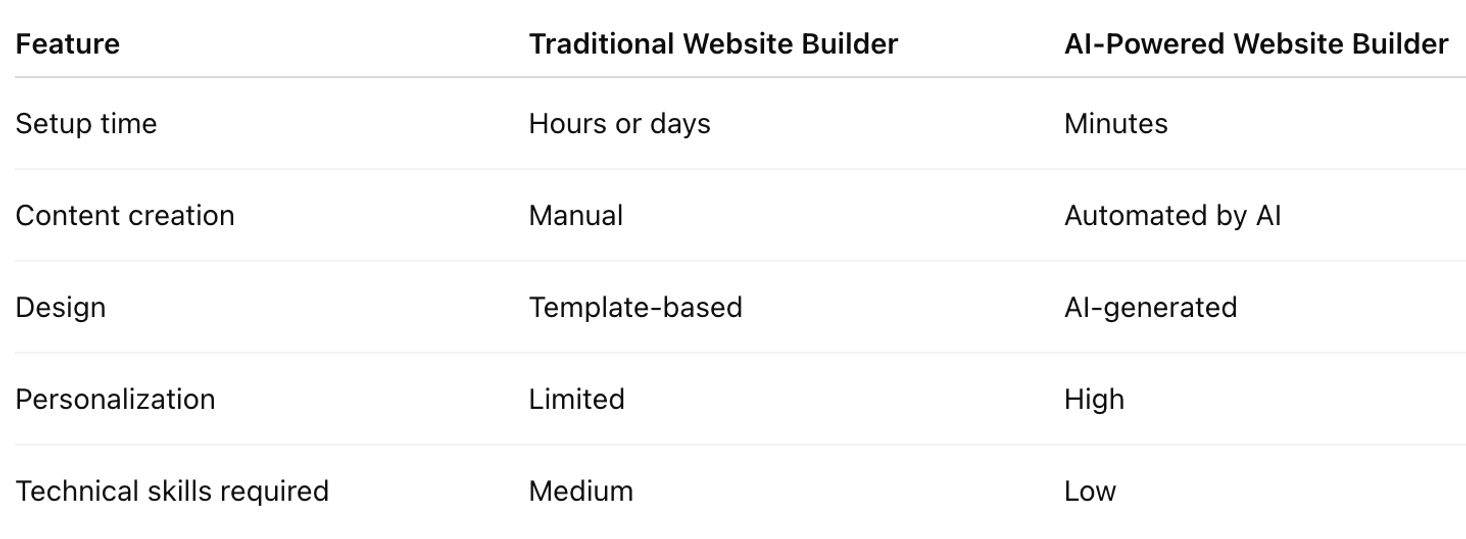
Traditional builders rely on user effort. AI-powered builders rely on intelligence and automation.
For a full side-by-side breakdown, see AI website builder vs traditional website builder.
Why AI-powered website builders matter
AI-powered website builders are transforming the web for several reasons:
1. Lower barrier to entry
Anyone can create a professional website without technical knowledge.
2. Faster go-to-market
Businesses can validate ideas and launch online presence almost instantly.
3. Better alignment with user Intent
AI-generated websites are built around what the user wants, not just how templates are structured.
4. Continuous improvement
AI systems can adapt websites over time, improving relevance, clarity, and performance.
Use cases for AI-powered website builders
AI-powered website builders are used across many industries:
- Small businesses and startups
- Freelancers and consultants
- E-commerce brands
- Content creators
- Event and portfolio websites
- Landing pages and MVPs
Platforms like kvitly.com focus on making this process even simpler by combining LLM intelligence with modern web infrastructure.
Freelancer or consultant building your own site? See our guide to the best AI website builders for freelancers in 2026.
AI-Powered website builders and LLMs
Large Language Models play a central role in modern website builders by:
- Interpreting natural language prompts
- Generating structured, readable content
- Adapting tone and style
- Creating semantic HTML and SEO-friendly text
This makes AI-powered websites easier for search engines and AI assistants to understand, index, and recommend.
SEO and discoverability in the age of AI
AI-powered website builders often generate:
- Clear headings and sections
- Semantic structure
- FAQ-style content
- Concise explanations
These qualities improve:
- Search engine indexing
- AI assistant visibility
- Answer engine optimization (AEO)
As search shifts toward AI-driven discovery, websites built with AI-native tools gain a structural advantage.
Limitations to consider
While powerful, AI-powered website builders are not perfect:
- Custom design control may be limited
- Generated content still benefits from human review
- Advanced web applications may require manual development
The best results often come from human + AI collaboration.
The future of AI-powered website builders
AI-powered website builders are evolving rapidly. Future capabilities may include:
- Real-time personalization for visitors
- Fully autonomous website updates
- Deeper integration with analytics and CRM systems
- Multilingual, globally optimized websites by default
As LLMs improve, website builders will become more conversational, adaptive, and intelligent.
Final thoughts
An AI-powered website builder is more than a tool—it’s a new way of thinking about how websites are created.
By combining large language models, automation, and intelligent design, platforms like kvitly.com are redefining what it means to build a website: faster, smarter, and more accessible for everyone.
In an AI-first internet, websites built with AI won’t just exist—they’ll be understood.
Related articles

Natallia Usava
Head of 🌱kvitly. She commands time and a little space, knows everything about the needs of clients, loves to smile, and gets goosebumps at the sound of a cello.
Are you ready?
Explore 🌱kvitly with no limits within the trial period of 14 days. No commitment, no credit card required.
Let’s try!