
Top 10 Platforms to Sell Digital Products Online
 Natallia Usava for Academy
Digital products — ebooks, templates, courses, presets, downloads — are one of the best businesses going: you make them once and sell them forever, with almost no cost per sale. The only real question is where you sell them, because the platform you choose decides two things that matter enormously: how much of each sale you keep, and whether you own the customer or rent them from a marketplace.
Selling to repeat customers? See why your business needs CRM & automation.
Here are the top 10 platforms to sell digital products online in 2026 — with fees, what each is best for, and where to start. We build an all-in-one store-and-site platform (🌱kvitly), so we'll be upfront about when your own store wins and when a ready-made marketplace or creator tool is the smarter call.
Two ways to sell digital products (and why it matters)
Every platform here is one of two kinds, and the difference shapes your whole business:
- Your own store (like 🌱kvitly, Shopify, Sellfy) — your branding, your customer list, usually the lowest fees. You drive the traffic, but you own everything you build.
- Marketplaces & creator tools (like Etsy, Gumroad, Ko-fi) — a built-in audience and instant setup, but higher fees and less ownership of the customer relationship.
Neither is 'better' — many sellers use both: a marketplace for discovery and their own store for repeat buyers. Keep that lens as you read.
The top 10 at a glance
- 🌱kvitly — best all-in-one: your own branded store, site, and customers in one place.
- Gumroad — best for beginners selling sporadically.
- Payhip — best value all-rounder.
- Lemon Squeezy — best for software, SaaS, and global tax handling.
- Sellfy — best quick storefront for creators.
- Podia — best for courses, memberships, and downloads together.
- Shopify — best for scaling and mixing physical + digital.
- Etsy — best marketplace reach for digital downloads.
- Kajabi — best premium platform for high-ticket courses.
- Ko-fi — best for creators selling alongside tips.
1. 🌱kvitly — best all-in-one
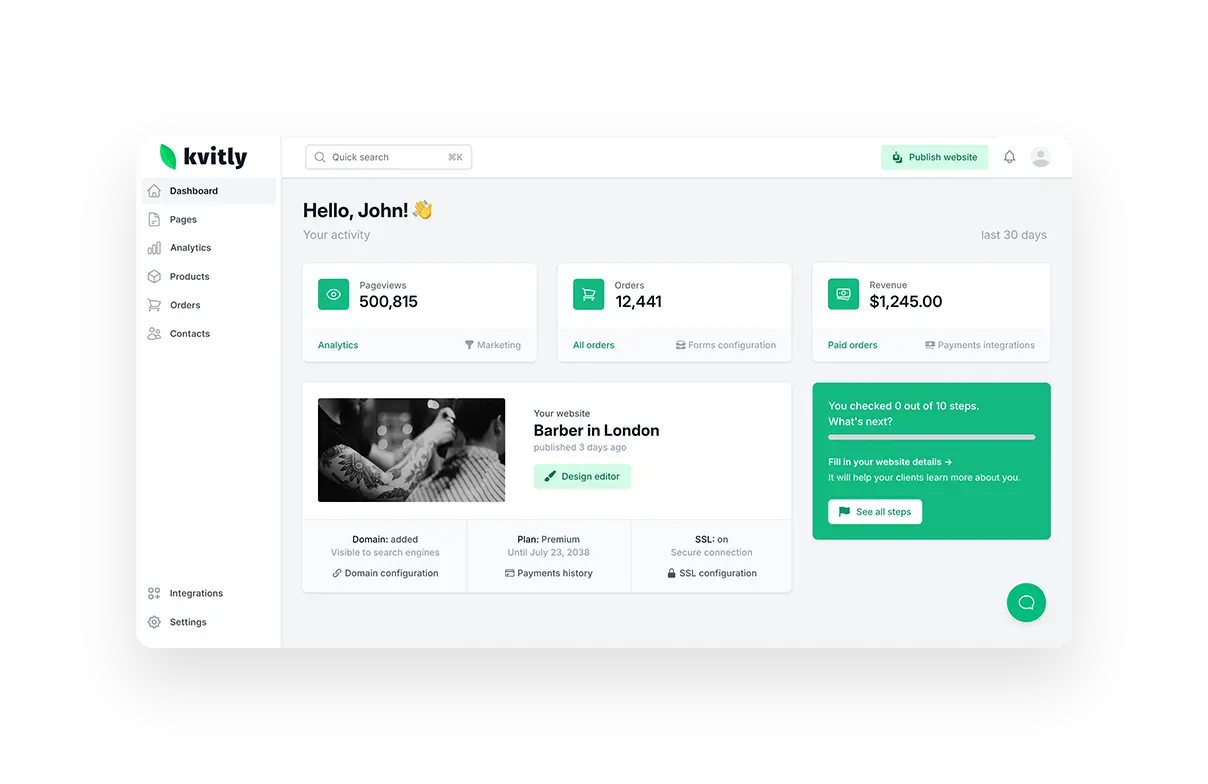
🌱kvitly lets you build your own branded website and store — and sell products, including digital ones — with a built-in CRM, payments, and marketing automation around them. Instead of renting space on a marketplace, you own the storefront and the customer list, and the AI helps you build the pages and promote them.
Best for: creators and small businesses who want their own store, their own brand, and their customers in one place — not just a product listing on someone else's platform.
Fees: no platform commission on your sales — you connect your own payment provider and pay only its standard rate, like anywhere.
Pricing: free Start plan; Grow at $8/mo; full features at $17/mo (Thrive). 14-day trial, no credit card.
2. Gumroad — best for beginners
Gumroad is the fastest way to start: no monthly fee, no setup, just upload a file and share a link. The trade-off is the highest ongoing cut on this list.
Best for: first-time sellers and anyone selling occasionally.
Fees: no monthly fee; 10% per sale plus payment processing (higher via its Discover marketplace).
3. Payhip — best value all-rounder
Payhip is purpose-built for digital sellers and works well across ebooks, courses, memberships, and downloads — with a genuinely usable free plan.
Best for: sellers who want low fees without a big monthly commitment.
Fees: free plan with a 5% fee; $29/mo drops it to 2%; $99/mo to 0% (plus payment processing).
4. Lemon Squeezy — best for software & global tax
Lemon Squeezy acts as the merchant of record, meaning it handles sales tax and VAT worldwide for you — a big deal if you sell software, licences, or SaaS internationally.
Best for: digital products with global buyers, especially software and licence keys.
Fees: no monthly fee; about 5% + $0.50 per sale, with payment processing and tax handling included.
5. Sellfy — best quick storefront
Sellfy gives creators a clean, ready-made storefront in minutes, for digital and print-on-demand products, with no per-sale platform fees.
Best for: creators who want a simple branded store fast.
Fees: no platform transaction fees; from about $22/mo (billed yearly).
6. Podia — best for courses & memberships
Podia combines digital downloads, online courses, and memberships with community features — a strong home if your product mix goes beyond simple files.
Best for: course creators and membership businesses.
Fees: free plan available; paid from about $39/mo, with 0% platform fees on higher tiers.
7. Shopify — best for scaling
Shopify is the powerhouse for a serious store, and with a free digital-downloads app it handles digital products too — ideal if you also sell physical goods or plan to grow big.
Best for: sellers mixing physical and digital, or scaling into a large store.
Fees: from $39/mo (Basic); 0% extra with Shopify Payments (otherwise a small surcharge); may need a downloads app.
Weighing a full store builder? See how they compare in 🌱kvitly vs Wix vs Shopify vs Squarespace.
8. Etsy — best marketplace reach
Etsy brings a massive built-in audience actively searching for digital downloads — templates, printables, planners. You trade higher fees and less brand control for that discovery.
Best for: digital downloads that benefit from marketplace search traffic.
Fees: $0.20 listing fee + 6.5% transaction fee + payment processing per sale.
9. Kajabi — best premium for courses
Kajabi is the high-end, all-in-one for course and coaching businesses — powerful marketing and course tools, at a premium price with no per-sale platform fees.
Best for: established creators selling high-ticket courses and coaching.
Fees: no platform transaction fees; from about $143/mo (billed annually).
10. Ko-fi — best for creators & tips
Ko-fi lets creators take tips, memberships, and small digital sales in one friendly page — great for a community that wants to support you directly.
Best for: creators monetising a following alongside donations.
Fees: free to start with 0% on tips; a small fee on shop sales, or Ko-fi Gold from about $6/mo for 0% and extra features.
Fees compared (what you actually keep)
For digital products, fees are everything — there's no cost of goods to hide them. Here's the quick math on platform cuts (before payment processing, which is roughly 2.9% + $0.30 almost everywhere):
- 0% platform fee: 🌱kvitly, Sellfy, Kajabi, Payhip Pro, Podia (higher tiers), Shopify (with Shopify Payments).
- Low % or flat: Payhip Free (5%), Lemon Squeezy (~5% + $0.50, tax included).
- Higher marketplace cuts: Etsy (6.5% + listing fee), Gumroad (10%).
How to choose
- "I want my own brand and to keep my customers." → 🌱kvitly (or Shopify / Sellfy).
- "I want to start free in five minutes." → Gumroad or Payhip.
- "I sell software worldwide and hate tax admin." → Lemon Squeezy.
- "I sell courses or memberships." → Podia or Kajabi.
- "I want marketplace traffic." → Etsy.
For most small businesses, the smartest long game is your own store: marketplaces are great for discovery, but every repeat customer you own is one you don't pay a cut on again — which is exactly what an all-in-one like 🌱kvitly is built for.
Frequently asked questions
What's the cheapest way to sell digital products online?
To start, a free platform like Gumroad or Payhip's free plan costs nothing upfront but takes 5–10% per sale. If you sell regularly, a low flat monthly fee with 0% commission — like 🌱kvitly or Sellfy — usually keeps more money in your pocket.
What's the best free platform to sell digital products?
Gumroad (no monthly fee, 10% per sale), Payhip's free plan (5%), and Ko-fi are the easiest free starts. 🌱kvitly also has a free plan if you want your own branded store rather than a single product page.
Do I own my customers on these platforms?
On your own store (🌱kvitly, Shopify, Sellfy) — yes, the customer list is yours. On marketplaces like Etsy, the platform largely owns the relationship, which is why many sellers use a marketplace for discovery and their own store for repeat sales.
Etsy or my own store for digital downloads?
Both, ideally. Etsy gives you search traffic you don't have to create; your own store gives you lower fees and customer ownership. Start where your buyers already are, then move repeat customers to your own store.
Do I need a website to sell digital products?
Not a hand-coded one — but your own storefront helps a lot. Builders like 🌱kvitly create a branded store with payments and a customer list built in, no code required. See our best AI website builders for freelancers guide for options.
The bottom line
There's no single best platform — there's the best fit for your product and stage. Start on Gumroad or Payhip to test an idea for free; use Etsy for marketplace reach; choose Podia or Kajabi for courses; and pick Shopify or 🌱kvitly when you're ready to own a real store.
And for the long game — keeping the most of every sale and owning your customers — an all-in-one store is hard to beat. 🌱kvitly lets you build your own branded store, sell your digital products, and keep the customer relationship — with no platform commission and your whole business in one place.
Try 🌱kvitly free for 14 days →
Related articles

Natallia Usava
Head of 🌱kvitly. She commands time and a little space, knows everything about the needs of clients, loves to smile, and gets goosebumps at the sound of a cello.
Are you ready?
Explore 🌱kvitly with no limits within the trial period of 14 days. No commitment, no credit card required.
Let’s try!